What marketing leaders need right now

The marketing landscape has gotten confusing.
Marketers across the board are being asked to do more with less. Fewer headcount approvals, leaner teams, tighter budgets. At the same time, the scope of what we're expected to own has exploded. And now there’s AI on top of it, which means the pressure to produce more, faster, has increased.
Anytime anything gets confusing, I try to do one thing: have some quality conversations.
This is a synthesis of 18 conversations I had with marketing leaders. Each was coded independently, then scored and ranked. Names withheld, roles and industries only.
Summary:
18 marketing leaders (CMOs, VPs, Head of)
~14 industries
at 25–3,000 employee companies
~9 hours of conversation
Main research question: “What are marketers’ intense needs right now?”
Every conversation was coded on its own before any pattern-hunting, so each story stayed intact instead of getting averaged into mush. Then each recurring need was scored on five dimensions (strategic impact, frequency, emotional resonance, actionability, and surprise) out of 25. Quotes are exact language.
The core takeaway
Current priorities have shifted away from initial AI implementation. Instead, leaders are grappling with the resulting friction: determining automation boundaries, protecting headcount, maintaining a coherent brand narrative amid shifting tech stacks, and managing exhaustion. From one growth leader: “every marketer is feeling a little expedited about it… it was always challenging, but now it’s a little extra.”
First, what's going well
Not everything was hard, though. Most leaders I spoke with started by talking about the good stuff. Like how everyone on their team finally has one clear job to do. Some teams even hit their goals, even in a tough season.
AI is helping a lot too. Work that used to take three whole weeks now takes just 40 minutes. And now everyone can see what customers and salespeople are saying, so good ideas turn into real messages much faster.
Teams with lots of old content found a hidden treasure: GEO and AI search is making that old stuff useful again. One leader called it a "blue ocean," wide-open water with no competition yet. Others said it's the biggest chance they've seen in years.
Marketing and sales are working together really well too. Marketing and sales alignment came up as a bright spot (one team now sources about 70% of pipeline, by sales’ own reporting).
And brand and creativity, the human work AI can’t do, was where leaders sounded most energized.
Now onto the hard stuff
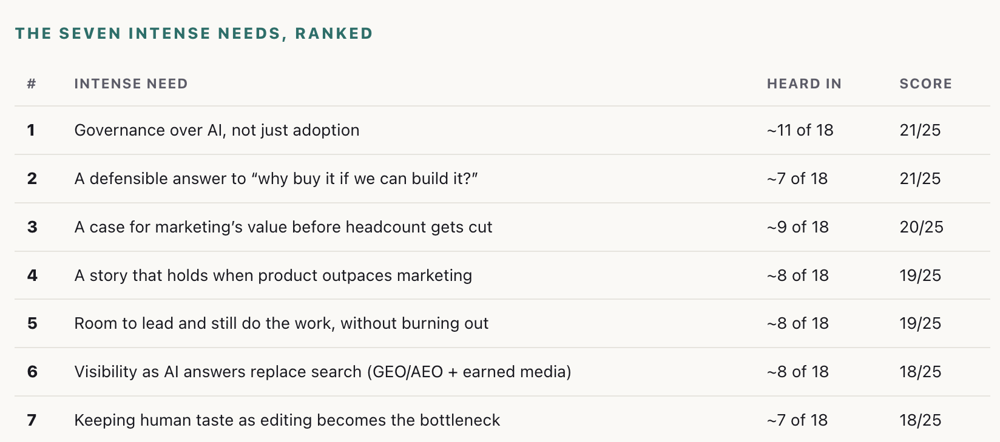

Leaders are trying to figure out which jobs the AI should do, which jobs need a real person, and how to stop everyone from trying random things on their own and start working the same way, together. The leaders who had the least trouble figured this out early, and they told everyone their plan.
“AI doesn’t know what to do unless you tell it… first you have to actually think through, what are the tasks that we do every day that are actually good candidates for automation?” Marketing lead — AI-forward research/education SaaS
“The harder part is knowing when to actually spend time on something with AI versus not.” VP / GTM leader — customer-engagement SaaS
“We need to change our ways of working… use AI in the right way. That is complex… going from piloting tools to actually changing ways of working — we’re not there yet.” VP Marketing — enterprise CPaaS
“What I decided to do… was actually build my own bespoke AI learning curriculum for the team… I just used AI to do it with me.” [later in the call] “This was not a ‘go do’ mandate. This was, we’re going to do it together.” VP Marketing — energy/commodities platform
What this means: the best fix of them all was a simple, clear rule about what AI is allowed to do and what it isn't. One leader kept a list e.g. this is okay for AI to do, this is not. The opposite keeps happening too: bosses say "use AI" without any plan, so people use it for small, unimportant stuff instead of things that actually matter. The calmest teams knew that making those clear rules was the real work and not just picking which AI tools to buy.

People who sell software and people who buy them are watching the whole way things work start to wobble, like a table with a wonky leg. Buyers are asking, "Why should I pay for this when I could just build my own with AI tool?" The old way of charging money where you pay for each person who uses the software is falling apart. Everybody's software can basically do the same stuff now. And it’s much bigger and scarier than "our special features aren't special anymore." Will our product even still exist? Will our whole way of doing business still exist?
“Every company is putting hopes and dreams on: if I just buy everybody a license to these LLMs, we can build these things ourselves… a lot of SaaS companies are in an existential mode right now — can we survive the AI apocalypse?” VP Marketing — qualitative-research SaaS
“We got out of HubSpot. We got out of Webflow. We got out of all of the marketing tools… we’re just going to build it in-house.” Head of Marketing — fintech / payments
“Competitors are moving so quickly because of agentic AI development that everybody has everything. So it’s either a race to the bottom on cost, or we add value beyond just the platform… SaaS is being judged on outcomes — can we do it with fewer seats and an MCP?” Head of Marketing — mid-market SaaS, landing pages + CRM
“People can now build stuff for free with [AI]… there’s very little appetite for anything that isn’t instant or can’t connect into your [AI] workflow. If there’s no MCP, then that’s it.” Head of Growth / PMM — GTM SaaS
What this means: This makes differentiation a survival question. As buyers can rebuild features themselves, what leaders pointed to as defensible was service, outcomes, and relationships, not the product on its own. The teams staying ahead are re-messaging around outcomes and defensibility to handle the “we’ll just build it ourselves” objection.

The more marketing proves AI works, the more leadership uses that proof to shrink or freeze the team, and to question whether marketing needs a leader at all. Teams are getting smaller. Headcount requests hit an “AI can do it” wall. In some companies, marketing is being pulled apart into other functions.
“The CEOs are seeing posts like ‘I have my AI doing the job of a five-person marketing team.’ So they’re like, you don’t need so many people… you might have had headcount that got taken away from you.” Head of Growth / PMM — GTM SaaS
“It’s harder to advocate now for new team members because people are aware of the value that AI brings, in particular for marketing.” Head of Marketing — ed-tech hardware
“We’re down to about 10… when people have been departing, we haven’t really been backfilling. Mid-market SaaS is particularly vulnerable.” Head of Marketing — mid-market SaaS
“Marketing as its own department… it’s falling apart… you don’t need a head of marketing anymore.” Head of Marketing — fintech / payments
BUT there’s a contradiction. One category-leading head of product marketing argued the opposite: “Does Jevons paradox apply to headcount? Should I be hiring more people, not less? How do I think about AI spend versus headcount spend?” This leader treated AI as a reason to consider hiring more, not fewer. The headcount trap is real, but in this set it tracked with how the business was doing, not necessarily with AI itself.
What this means: One of the most emotionally loaded needs in the set. Leaders feel the org chart moving and mostly don’t have a plan for it. The ones handling it best are spelling out what marketing actually does and why it isn’t a line item to trim. More than one leader admitted their own company doesn’t really understand what product marketing is for.

Engineering ships on a weekly, sometimes vertical, curve. Marketing, enablement, and the customer’s ability to absorb the change do not. At the same time, anyone can pump out endless content, so volume counts for nothing and the story is the only thing that sets you apart.
“Their velocity is going vertical and product marketing is not vertical, I just need to reconcile those two things.” [later in the call] “The rate of change has surpassed the human ability to keep up… Is it not about keeping a good feature velocity, but instead ensuring that the ground story is so strong that it doesn’t matter what features change?” Head of Product Marketing — commerce SaaS
“As all those water levels rise… everybody has the same amount of volume. How do we push out lots of content that is also differentiated? Discernment, discretion, differentiation.” CMO — health-tech
“The story is missing because there needs to be a through line… it’s not just ‘we have this feature and this feature.’ Needs to be a story.” CMO — cybersecurity-AI startup
“You need to build a narrative… You need a brand. You need a very good and compelling story for your target audience.” [later] “Messaging is key. Target audience, messaging, story — that’s number one.” Sr. Director, Growth Marketing — video-content SaaS
What this means: Brand and story are the last safe thing nobody can copy. The most useful shift leaders described: stop patching the launch playbook every release, and build one story durable enough to survive constant feature churn. Then give sales and CS a fast, self-serve way to stay current without hiring more people to keep them trained.

The same AI mandate that’s shrinking teams is pushing leaders back into hands-on creator work, all while they still run the team. The result is constant context-switching, no room for deep work, and open fatigue. Raised by roughly 8 of 18 so not the most frequent need, but the one voiced with the most personal strain: “I’m the bottleneck,” “on the weekends,” “exhausted.”
“It’s cool, but… it’s a different mind space. So you need to not be in 10,000 meetings to do that.” — and when asked when that focused work happens now: “On the weekends.” VP Marketing — employment-data infrastructure SaaS.
“It’s a lot of context switching right now… it’s harder to feel like you can make something great when you’re balancing 10 things when in the past you balanced three.” Head of Growth / PMM — GTM SaaS
“The difficult part is usually not doing the work, but the coordination in between — meetings, alignment. That’s the stuff that cannot be automated.” VP Global Brand & Campaigns — enterprise CPaaS
“People just feel exhausted, because whatever you do today, there’s something more that you need to do tomorrow.” CMO — health-tech
What this means: Not the most frequent need (that’s AI governance) but the one that carried the most personal strain. Leaders described themselves as the bottleneck, fragmented, exhausted, doing the real work at night and on weekends. What they said would help: protect deep-work time, and hand the repeatable, lower-judgment work to systems so scarce hours go to strategy and craft.

AI is now answering people's questions before they even visit a website, so the old way of showing up on Google isn't working the same anymore. To get noticed now you have to show up in lots of different places at once. One leader counted six different spots.
It's also getting harder to tell which of your efforts are actually working, since people often get their answer without ever clicking a link. Because of this, things like getting mentioned by others, having other people vouch for you, and building real relationships are becoming more important.
“Inbound is drying up and organic traffic is drying up because of AI. They have all these AI answers — they don’t need to come to your site as often. Last year that wasn’t the case.” Head of Marketing — content-ops SaaS
“Before, you just thought about ranking for Google. Now there are six different platforms that all play very differently… now you have to do well in all of them.” Head of Growth / PMM — GTM SaaS
“Earned media is becoming more and more important… it’s third-party validation that’s making people’s stuff stand out.” CMO — health-tech
“It’s very hard to allocate spend to revenue now — with zero-click and GDPR… trust is difficult.” Sr. Director, Growth Marketing — video-content SaaS
But there’s nuance. For inbound-dependent teams this is a threat (“inbound is drying up”). For teams with a decade of content or a strong brand, it’s the biggest opportunity in years: “GEO has blown SEO out of the water…it lets brands compete in a blue ocean…who’s talking about you really matters” and “we’re seeing a lot of demand from AI search…if you’re not heavy in AI search you’re missing the boat.” Whether GEO is a tailwind or a threat comes down to whether a brand already owns earned authority.
What this means: Things like getting written about in the news, showing up on Reddit, getting good reviews, and teaming up with other companies and people (influencers) are becoming more valuable exactly because a robot can't do that for you. They need real relationships and good judgment, not just something a machine can spit out. Learning about your customers and telling good stories now directly helps people find your brand, because what AI says about you depends on what other people out there are already saying about you.

AI made the first draft instant and pushed the cost to the back end: hours of editing, fact-checking, and lost control over the details, especially the “final 15%.” Leaders can smell AI output on sight and the scarce resource now is taste. As one leader put it, it should be “a tool, not a crutch.”
“It’s tough to get [the AI], even with a truth prompt, to stop hallucinating. And sources — some of the claims are just totally made up.” [minutes later] “Feedback and creative direction for design is very challenging now in that final 15% of a project — can’t make those fine-tuning tweaks. And that’s frustrating.” Head of Marketing — ed-tech hardware
“We want people to be AI enabled, but there’s also the craft… you want it to be a tool, not a crutch.” [on a designer candidate, later in the call] “One person just threw the entire web page into [an AI tool]… it changed the logo, and the answer was, oh, that was just AI.” VP Marketing — employment-data infrastructure SaaS
“This paragraph sounds exactly like AI. Don’t use the word ‘quietly.’” VP Marketing — energy/commodities platform
“Everyone’s like, here’s my skill drop. I’m like, trash, trash, trash, trash. Like, you look at it and you’re like, wow.” […later in the same call…] “You also have to have, like, the taste, the eye for what is this giving me.” VP / GTM leader — customer-engagement SaaS
What this means: AI makes the first draft instant, but it moves the real work downstream. Leaders spend more time editing, fact-checking, and fixing tone, and they can spot AI copy on sight. The teams pulling ahead don’t just hand the writing to mass AI tools. They keep a person in charge of judgment and taste, use AI to get to a rough draft fast, and shape it from there. The teams pulling way ahead are building a “messaging brain” (like Mojo) so the first draft comes back 95% done.
Overall, the mood is split
Over and over, leaders described feeling two ways about AI at the same time. Excited by what it lets them do, and worried or worn down by it. And they refused to be cast as either an AI cheerleader or an AI skeptic. It’s the tone these leaders are actually living in, and it’s the opposite of the pick-a-side arguments we see online.
“It’s amazing us and scaring us at the same time.” Head of Marketing — fintech
“It’s equally existential while also… it could overtake us, and it could also be our savior.” VP Marketing — research SaaS
“It’s always both. You should do both.” CMO — compliance-training SaaS
Some outliers worth noting
The confident high-performers. A few leaders at category-leading, bootstrapped, or hyper-growth brands showed little of the AI dread heard elsewhere. Their “hard” was scaling and hiring, and one kept returning to the phrase “it’s a solvable problem.”
The far edge of build-vs-buy. One fintech leader had already ripped out the entire marketing stack to build in-house, and openly predicted marketing dissolving into other departments. Extreme today, but I’m watching this because who knows maybe this will become more popular.
PMM hiring. For one of the fastest-growing startups in the set, the single biggest need was hiring a founding product marketer to bring story discipline to a feature firehose.
And that about wraps it
Liked this report? Share it with a marketing leader friend.